News
Glass to Glass – Building trust with C2PA Broadcasters and tech companies unite around C2PA
By: Kaori Iida, Deputy Director, News Department, NHK (Japan Broadcasting Corporation)
As generative AI makes fabricated images and video harder to spot, broadcasters face a growing challenge. How can audiences know where content came from and what happened to it along the way?
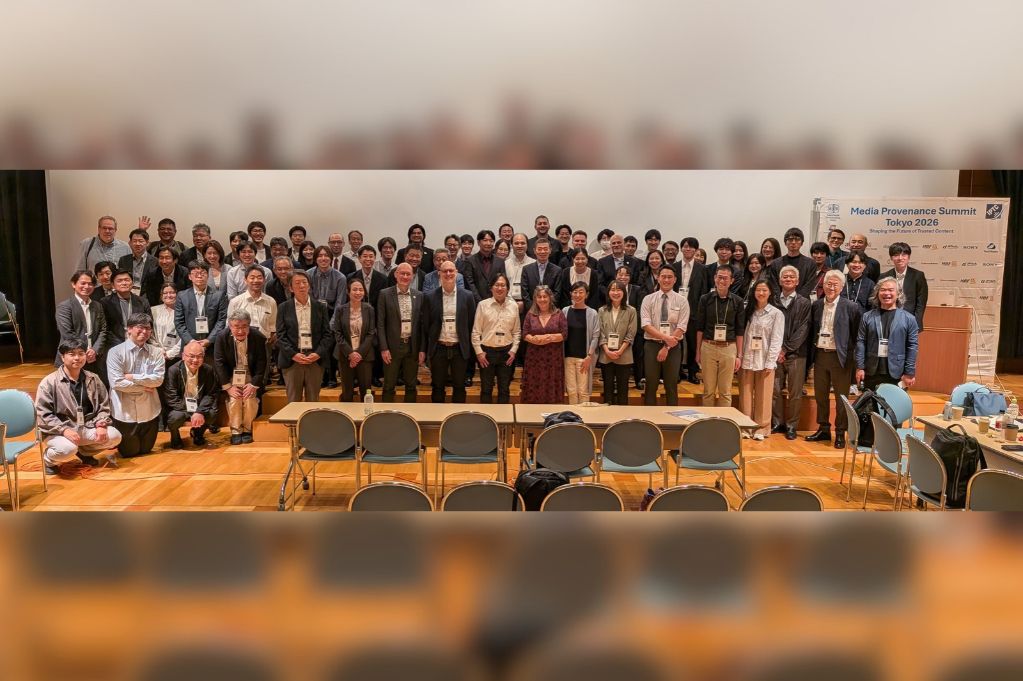
That question brought 200 participants from eight countries to the Media Provenance Summit Tokyo 2026 on October 13. The meeting was hosted by the Asia-Pacific Broadcasting Union (ABU), with co-organising support from the International Press Telecommunications Council (IPTC) and the NHK Foundation.
The discussions focused on C2PA and on how it can move from trials into everyday media operations.
Why C2PA matters
C2PA, the Coalition for Content Provenance and Authenticity standard, gives media organisations a common way to attach a digitally signed record to a piece of content. This record can show who published it and, depending on the workflow, how it was created or edited.
It is important, however, to understand what C2PA does not do. It does not automatically determine whether the claims made in a video or photograph are true. Instead, it provides information that journalists, platforms and audiences can use when making that judgement.
For broadcasters, this is increasingly important because news is no longer consumed only through their own TV channels, apps or websites. It is copied, clipped and redistributed through social media, video platforms and increasingly, AI-powered services. The broadcaster’s familiar branding may be removed along the way, but a secure record of provenance can travel with the content.
The Summit therefore looked beyond the technology itself. Trusted journalism needs to remain identifiable wherever audiences encounter it.
From lens to screen
NHK presented its work to incorporate C2PA into broadcasting and newsroom operations, including a prototype “glass-to-glass” system developed by its Science & Technology Research Laboratories. The aim is to maintain provenance information from the camera lens through production and distribution to the screen on which the audience sees the content.
The presentation showed that the main technical components for such an end-to-end system are emerging. However, challenges remain in connecting the different stages of the production and distribution chain and in presenting provenance information to audiences in a clear and useful way.
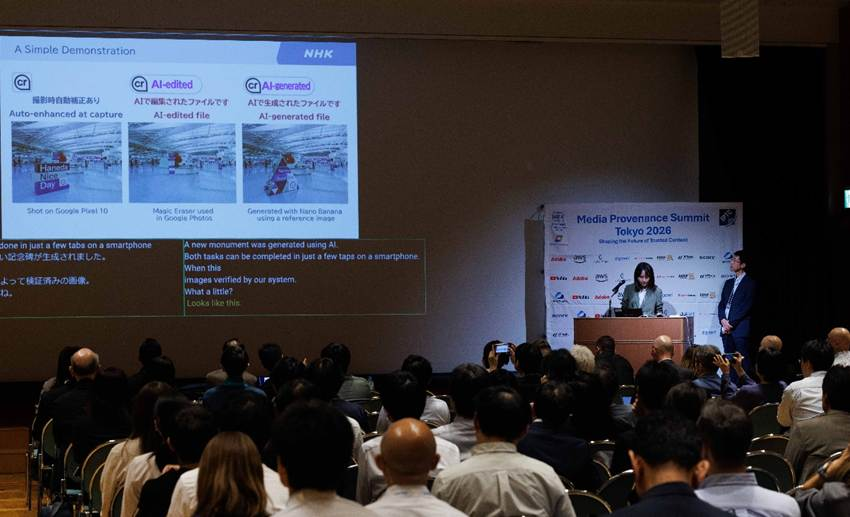
The message was also pragmatic. Broadcasters do not have to wait until every part of the “glass-to-glass” chain is complete. They can begin with achievable steps such as digitally signing content at the point of publication so that recipients can verify its source.
NHK’s experience also underlined a central lesson from the Summit. Implementation by a single broadcaster is not enough. Provenance becomes more useful when cameras, editing systems, broadcasters and online platforms can recognise and preserve the same information.
Beyond news
Brendan Quinn of IPTC described Fuji Television’s presentation as “the surprise of the day.” IPTC has been working with broadcasters around the world on media provenance, making his reaction particularly striking. Fuji Television revealed it has been using C2PA on air since June 2025 in its advertising system, allowing provenance information about who made and approved an advertisement to be verified and displayed to viewers.
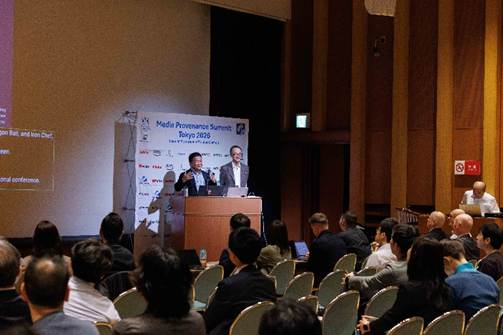
The case widened the discussion beyond news verification. For Fuji Television, provenance can support the safety and accountability of advertising by helping confirm who supplied material and which organisation reviewed it before broadcast.
This points to a practical route towards wider adoption. C2PA is more likely to be widely adopted when it solves an immediate business or operational challenge, whether that is protecting a broadcaster’s identity, improving advertising accountability or helping journalists verify incoming material.
Making the case to leaders
I moderated a session with representatives from the British Broadcasting Corporation (BBC), Ukraine’s public broadcaster Suspilne, Singapore’s Mediacorp and the IPTC. The discussion had a practical objective. We wanted to help people in the room persuade their bosses to take provenance seriously.

I asked what had prompted each organisation to act, how audiences decide what to trust and what argument would be likely to secure support from senior management.
Laura Ellis of the BBC described fake content that had circulated using the BBC’s logo and voices resembling those of its journalists. The need to help audiences distinguish genuine BBC journalism from others helped raise awareness of provenance within the newsroom.
She also pointed to the risks created when AI-generated news summaries alter facts or lose important nuances in the original reporting. She positioned C2PA as one part of a broader effort to protect trust across the information environment.
Earlier in the Summit, Willy Tan of Mediacorp noted that “technology cannot solve the question of ‘is it true?’” I asked him to elaborate during our session.
His point went to the heart of what provenance can and cannot achieve. C2PA can provide evidence about the source and history of digital content. But a verified source does not, by itself, prove that every claim in the content is accurate. Establishing truth still requires editorial judgement, verification and responsible journalism.
At the same time, Tan emphasised the importance of adapting to audience behavior. Younger consumers may never visit a broadcaster’s own website, even when they encounter its journalism on platforms such as TikTok. The challenge is therefore to deliver news where audiences already are, while giving them a way to verify that it genuinely came from the broadcaster.
Dmytro Khilchenko of Suspilne Ukraine made the risk even clearer. Borrowing a line from Star Wars, he warned established media organisations, “Your overconfidence is your weakness.”
A familiar name and a long record of public service can no longer guarantee that audiences will recognise a broadcaster’s journalism as authentic, particularly when it has been detached from its original platform and redistributed online. Nor can broadcasters assume that AI systems or social media algorithms will automatically identify them as authoritative sources.
For Suspilne, this is not a theoretical concern. Operating during the war, the public broadcaster faces AI-generated content and coordinated information attacks alongside a wider decline in direct traffic to news websites. Khilchenko expressed the stakes. “The currency of public media is trust.”
If a news organisation cannot be recognised as a credible source by audiences, platforms and AI systems, it risks losing both its visibility and the trust on which its public role depends.
The session made clear that the case presented to management cannot be based on technology alone. Provenance is about protecting a broadcaster’s reputation, maintaining its visibility and ensuring that its journalism remains identifiable as it travels through an increasingly fragmented information environment.
Building trust together
The Tokyo Summit brought international experts, broadcasters and technology companies together to share practical approaches to C2PA. IPTC’s Quinn even arranged to have 150 copies of the new 80-page edition of Media Provenance for News Publishers printed in Japan and distributed them to participants.
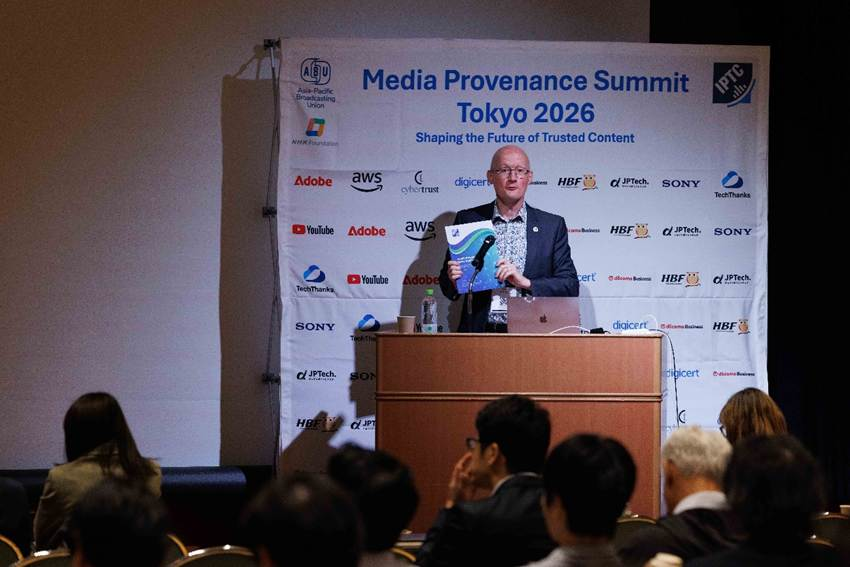
For provenance to work, the provenance record must survive distribution, be displayed by platforms and be understood by the audience. This requires common standards, compatible tools and workable newsroom processes.
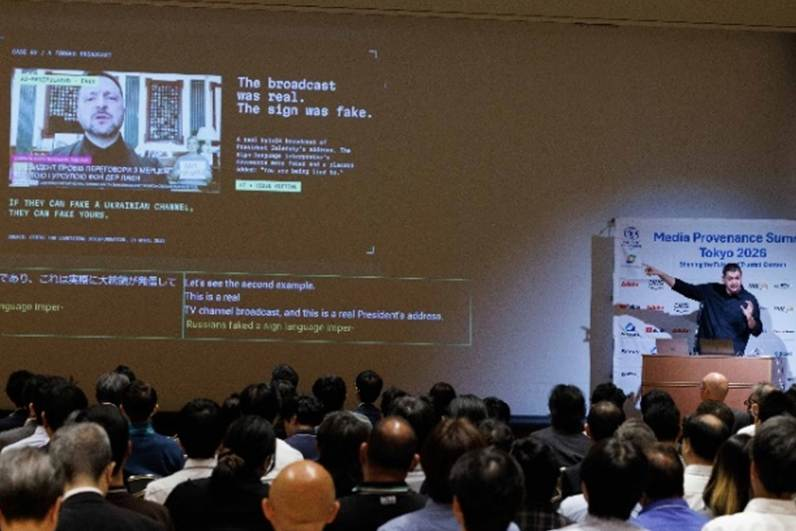
The strongest message from Tokyo was that no broadcaster, platform or technology company can create a trusted information environment by itself. Khilchenko summed it up simply. “Provenance only works when we come together.”
============================================
Kaori Iida leads operational reforms and oversees AI integration across NHK’s newsrooms, helping shape the future of news production and delivery at Japan’s public broadcaster.
Before assuming her current role, she served as Senior Commentator, covering tech, finance and trade policies. Prior to that, she led NHK’s Digital News Division, overseeing digital news distribution and social media initiatives across multiple platforms, where she led NHK’s transformation in digital innovation, platform engagement and information integrity.
Our Latest News
Discover More News

Beyond the Haze: Media, Accountability and ASEAN