News
Constructive journalism can survive in Malaysia…
Constructive journalism can survive in Malaysia, but only if journalists are free to say “This Failed”.
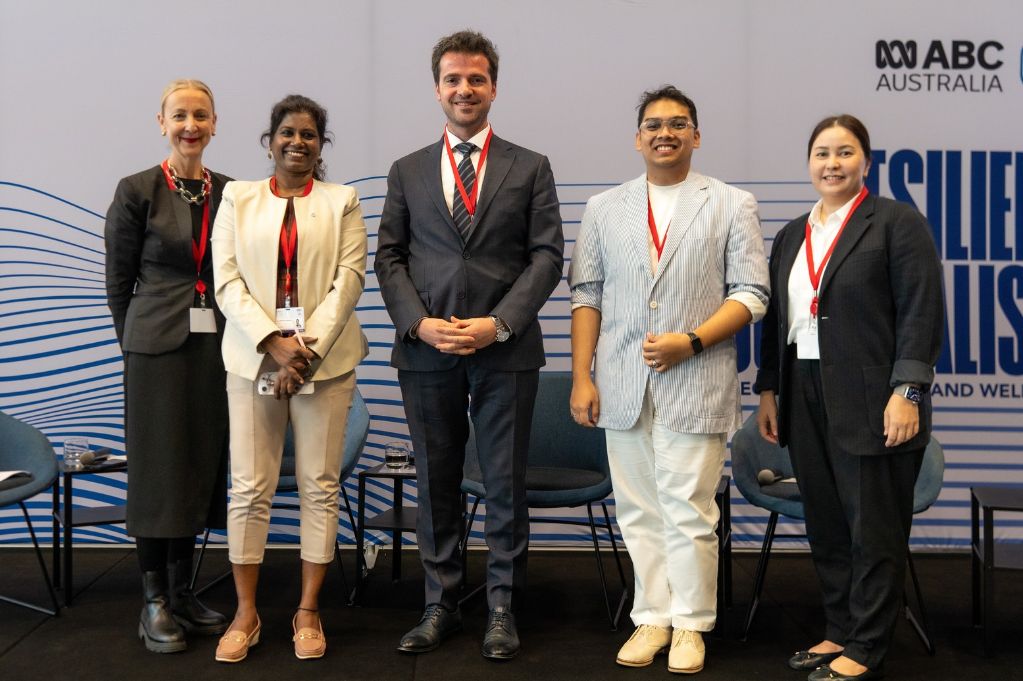
Not long ago I sat on a panel at the Global News Forum in Sydney, talking about constructive journalism. Kate Torney, Director of the Constructive Institute Asia Pacific at Monash University, moderated. Next to me were Leela Meenatchi Mariappan, Director of DD News India, Clare Patchimanon, Director of Thai PBS World, and Hamza Bayrak, Director of TRT World in Türkiye. Three people who run international newsrooms, and me, the Malaysian academic. I’m fairly sure I was the token scholar.
It was a fun session. A few people came up to me afterwards, some because they saw their own newsrooms in what I’d described, others because they’d enjoyed the colour and the jokes. I’ll take both. But a panel slot is only so long, and I left with half my argument still in my pocket. Here’s the other half.
One moment stayed with me. Clare Patchimanon raised an interesting point about how often Thai PBS covers poverty in Thailand. It made me think of how poverty stories usually go back home. A minister arrives, an envelope or a bag of groceries changes hands, the cameras roll, and that’s the story. Nobody goes back a year later to ask whether the family is better off. That’s exactly the gap constructive journalism is meant to fill, and exactly where it’s most easily tamed.

Nobody at that forum needed convincing that the idea has merit. People are tired of news that leaves them feeling helpless. But covering a solution honestly means being able to say, when the evidence points that way, that it didn’t work. So, can constructive journalism survive in a country where saying “this failed” has never come cheap?
It’s a fussy plant. It needs money for slow reporting, data to check claims, access to the people running things, a legal climate that tolerates an unflattering verdict, and readers who believe a hopeful story wasn’t paid for. Denmark, where the Constructive Institute was born, has all five. Malaysia rations each one, and our newsrooms still remember the permits, Ops Lalang and ribbon-cutting on the eight o’clock news, when nothing announced was ever allowed to fail.
Want a live example? Look at Bangun KL. Federal Territories Minister Hannah Yeoh launched it in April 2026 with Zus Coffee, whose 250 outlets in KL and Putrajaya give app users about 30 per cent off between 7am and 8am. The logic is that around 1.2 million vehicles enter Kuala Lumpur each morning, so shifting even one in ten earlier should ease traffic. Plenty of Malaysians weren’t buying it. Critics called it insensitive and simplistic, pointing out that the roads and highways are already jammed at 6:00am. Others wanted to know why a cheaper latte was being offered instead of better first-mile transit, flexible office hours or housing that doesn’t push workers further and further out of the city. Best case, the jam just starts earlier. Worst case, we lose more sleep over a problem the government hasn’t fixed. Yeoh’s reply is that the government’s money is limited, so working with private companies is essential.
For journalists, this is where it gets interesting. The brochure story writes itself. Minister, barista, happy commuter, discount code. A constructive story asks the annoying questions. How many drivers actually changed their routine, and who’s counting? Did the 8am peak shrink, or did we just create a new one at 7am? None of that is hostile. It’s the job. But each question carries an answer nobody in power wants printed, and almost everything about our media landscape makes the brochure easier to publish than “this failed”.
Start with money. Newsrooms here have been shrinking for a decade as ad revenue drifted to Google, Meta and TikTok. Testing Bangun KL properly means traffic data, commuter interviews and weeks of work, for a story that will rarely out-click a 3R row over race, religion or royalty. So, funding comes from ministries, GLCs and CSR budgets keen on “impact storytelling”. Good luck telling a sponsor that the programme it paid you to cover didn’t work.
Data is the next headache. We still have no federal freedom of information law. A bill was tabled in July, but it’s now stuck with a select committee after the Centre for Law and Democracy scored it 47 out of 150, and it wouldn’t override our secrecy laws anyway. With Bangun KL, the best record of whether anyone changed their commute sits inside a coffee chain’s app. If the only proof that something worked comes from the people who designed it, you haven’t reported on a solution. You’ve published their KPI.
Then there’s access, which works like currency here, and friendly news outlets get paid first. Add the Sedition Act, Section 233 of the Communications and Multimedia Act, and new online platform rules, and nobody needs to give orders. Editors do the maths themselves. Everyone has to protect their livelihood, I get it. But that’s how constructive journalism becomes flattery with a better CV.
Trust may be the hardest of all. Many Malaysians assumed Bangun KL was a marketing campaign first and a traffic plan second. That may be unfair, but it shows how readers treat anything that smells like government-backed good news. And here’s the irony. Readers only believe a newsroom’s good news once they’ve seen it publish bad news about the same people. “This worked” means nothing from a newsroom that has never said “this failed”.

So, will constructive journalism survive here? Almost certainly. The question is in what shape. There’s the brochure, where the label lives on and the method dies. There’s the boutique, done properly by a few independent outlets on grants and goodwill, always one funding cycle from folding. And there’s the backbone, where it’s simply how the whole newsroom works, verdicts and all. That’s the one worth having, and the one our landscape does least to help.
The backbone is also far more uncomfortable for the powerful than its sponsors realise. Bangun KL runs until 31 December. A backbone newsroom would go back in January and count cars and return to every poverty programme a year after its launch ceremony. If it worked, say so. If it didn’t, say that too. To be fair, nudges are cheap and sometimes work, and a minister experimenting on a tight budget isn’t a scandal. Cynicism isn’t independence. But getting there takes readers willing to pay, an FOI law with real teeth, and a Media Council that makes outlets disclose who funds their impact reporting. Editors could also use a simple test. If a solutions story could never embarrass the person offering the solution, it isn’t one.
Sitting in Sydney with colleagues from India, Türkiye, Thailand and Australia, I realised each of our countries rations these five things differently. The idea will travel anywhere. Whether it arrives here as a brochure, a boutique or a backbone comes down to one stubborn freedom. Journalists must be able to check the evidence and write two words without fear. This failed.
Next time, I’m asking for a longer slot.
Written by: Dr Naim Muhamad Ali
Muhammad Naim Muhamad Ali, PhD, also known by the moniker Naim Leigh, is a Senior Lecturer at the Faculty of Applied Communication, Multimedia University Cyberjaya from Malaysia. The views expressed in this article are his own and do not necessarily reflect those of Asia-Pacific Broadcasting Union.
Our Latest News
Discover More News


Beyond the Haze: Media, Accountability and ASEAN